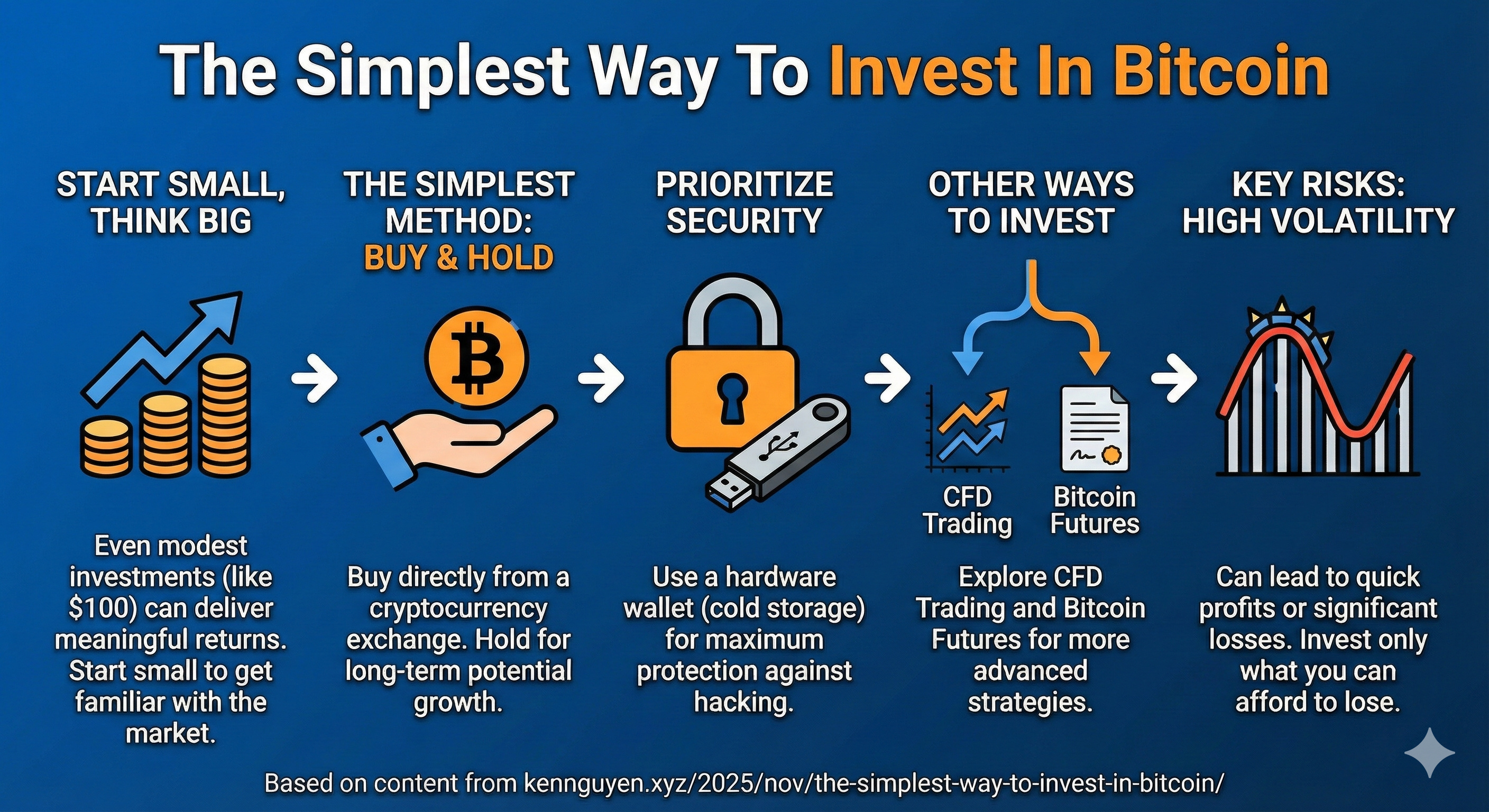
The Simplest Way to Invest in Bitcoin
Introduction: Why Bitcoin Still Matters
Bitcoin has cemented itself as the most dominant cryptocurrency in the world. Despite volatility, regulatory debates, and waves of skepticism, it remains the most secure, decentralized, and widely adopted digital asset.
For many investors, Bitcoin is not just another speculative instrument, it’s a hedge against inflation, a store of value, and a bet on the future of decentralized finance.
But here’s the challenge: Bitcoin’s price swings are legendary. It can surge 50% in a month and crash 30% in a week. For newcomers, this volatility is intimidating. For veterans, it’s an opportunity. The question is: how do you invest in Bitcoin without losing sleep?
The simplest answer is Dollar‑Cost Averaging (DCA). But beyond DCA, there are refined strategies that can improve your returns if applied with discipline. Let’s explore them.
The Simplicity of Dollar‑Cost Averaging (DCA)
What is DCA?
Dollar‑Cost Averaging is the practice of investing a fixed amount of money into Bitcoin at regular intervals: weekly, bi‑weekly, or monthly, regardless of its price.
For example:
- You decide to invest $200 every month into Bitcoin.
- Whether Bitcoin is at $50,000 or $100,000, you buy $200 worth.
- Over time, you accumulate Bitcoin at an average cost that smooths out volatility.
Why DCA Works
- Removes emotion from investing: You don’t have to time the market.
- Builds discipline: Consistency beats impulsive trading.
- Captures long‑term growth: Bitcoin has historically trended upward over multi‑year horizons.
- Reduces regret: You won’t feel like you “missed the bottom” or “bought the top.”
DCA is the most beginner‑friendly strategy. It’s simple, effective, and requires minimal effort. But while DCA is great, it’s not necessarily the most optimal way to maximize ROI. That’s where more advanced strategies come in.
Smarter DCA: Buy After Crashes
The Logic Behind Post-Crash DCA
Bitcoin’s history is full of sharp corrections. After euphoric rallies, it often retraces 30–50%. Instead of blindly buying every week, some investors prefer to DCA only after significant crashes.
For example:
- You set a rule: only buy if Bitcoin drops 20% or more from its recent high.
- This way, you accumulate more Bitcoin at discounted prices.
Benefits
- Improved average cost basis: You’re buying when others are fearful.
- Psychological advantage: You feel like you’re “buying the dip” rather than chasing highs.
- Capital efficiency: Your money is deployed at moments of maximum opportunity.
Risks
- Missed rallies: If Bitcoin keeps climbing without major pullbacks, you may accumulate less.
- Requires patience: You might wait months before your buy triggers.
This strategy is essentially a hybrid: it keeps the discipline of DCA but adds a filter to avoid buying during overheated markets.
Avoid Buying During Bull Runs
The Mistake Many Make
When Bitcoin starts a bull run, FOMO (Fear of Missing Out) kicks in. New investors rush to buy, often at inflated prices. This increases their average cost basis, making it harder to profit long‑term.
Smarter Approach
- Pause DCA during strong bull runs.
- Resume buying only after corrections or consolidations.
For example:
- Bitcoin surges from $60,000 to $100,000 in three months.
- Instead of buying at $100,000, you wait for a retracement to $80,000.
Why This Works
- Protects ROI: You avoid chasing parabolic moves.
- Keeps discipline: You’re not swayed by hype.
- Long‑term focus: Bitcoin cycles always include corrections.
This strategy requires resisting FOMO, which is easier said than done. But disciplined investors know that patience often pays more than impulsivity.
Altcoins: Rotate Profits Back Into Bitcoin
The Reality of Altcoins
Altcoins (cryptocurrencies other than Bitcoin) can deliver explosive short‑term gains. But history shows that most altcoins trend toward zero over long periods. Projects fail, hype fades, and liquidity dries up.
Smarter Strategy
- Use altcoins for speculation.
- Rotate profits back into Bitcoin.
For example:
- You invest $1,000 in an altcoin.
- It doubles to $2,000.
- Instead of holding, you take profits and convert them into Bitcoin.
Why This Works
- Preserves gains: You lock in profits before altcoins collapse.
- Builds Bitcoin stack: You steadily increase your BTC holdings.
- Avoids long‑term decay: Bitcoin has proven resilience; most altcoins haven’t.
The Expensive Lesson
During the 2017 bull run, many altcoins surged thousands of percent. By 2018, most had lost 90–99% of their value. Investors who rotated profits into Bitcoin preserved wealth. Those who held altcoins often lost everything.
This strategy acknowledges altcoins as speculative vehicles but treats Bitcoin as the ultimate store of value.
Lend Bitcoin in DeFi Protocols
The Rise of DeFi
Decentralized Finance (DeFi) allows you to lend, borrow, and earn yield without intermediaries. Platforms like Aave and Compound let you deposit Bitcoin (wrapped BTC on Ethereum or native BTC on certain protocols) and earn interest.
Strategy: Lend BTC, Borrow Stablecoins in Bear Markets
- Deposit BTC into a reputable DeFi protocol.
- Borrow stablecoins (like USDC or DAI) against your BTC collateral.
- Use stablecoins to cover expenses or reinvest during bear markets.
Benefits
- Passive income: Earn yield on your Bitcoin.
- Liquidity without selling: You can access funds without triggering taxable events.
- Bear market resilience: Borrowing stablecoins lets you survive downturns without liquidating BTC.
Risks
- Smart contract risk: Bugs or exploits can cause losses.
- Liquidation risk: If Bitcoin’s price drops too much, your collateral may be liquidated.
- Protocol risk: Only use reputable platforms with strong audits.
This strategy is advanced and requires careful risk management. But for disciplined investors, it can enhance ROI while preserving long‑term Bitcoin holdings.
Putting It All Together
Beginner Path
- Start with simple DCA.
- Build a base of Bitcoin holdings.
Intermediate Path
- Adjust DCA to buy after crashes.
- Avoid buying during euphoric bull runs.
Advanced Path
- Speculate in altcoins but rotate profits into Bitcoin.
- Lend BTC in DeFi protocols and borrow stablecoins strategically.
By layering these strategies, you move from passive accumulation to active optimization. The key is discipline: stick to rules, avoid emotional decisions, and always prioritize Bitcoin as the core of your portfolio.
Psychological Discipline
Investing in Bitcoin is not just about numbers — it’s about psychology.
- Resist FOMO: Don’t chase rallies.
- Embrace fear: Buy when others panic.
- Think long‑term: Bitcoin’s cycles are measured in years, not weeks.
- Stay humble: No one can perfectly time the market.
The best investors are not those who predict every move but those who stay consistent and disciplined.
Bitcoin is still in its early adoption phase. Institutional investors, sovereign wealth funds, and even governments are beginning to explore it. As adoption grows, Bitcoin’s scarcity (only 21 million coins will ever exist) becomes more pronounced.
By accumulating Bitcoin through disciplined strategies, you’re not just chasing ROI, you’re positioning yourself for a future where Bitcoin could play a central role in global finance.
Conclusion
The simplest way to invest in Bitcoin is Dollar‑Cost Averaging. It’s beginner‑friendly, stress‑free, and effective. But to maximize ROI, investors can refine their approach:
- DCA after crashes.
- Avoid buying during bull runs.
- Rotate altcoin profits back into Bitcoin.
- Lend BTC in reputable DeFi protocols and borrow stablecoins in bear markets.
These strategies require discipline, patience, and risk management. But for those who master them, the reward is not just financial, it’s the peace of mind that comes from knowing you’re investing intelligently in the most resilient digital asset of our time.